

- This event has passed.
SACAC Workshop: Observer Design For Dynamic Systems (Pretoria)
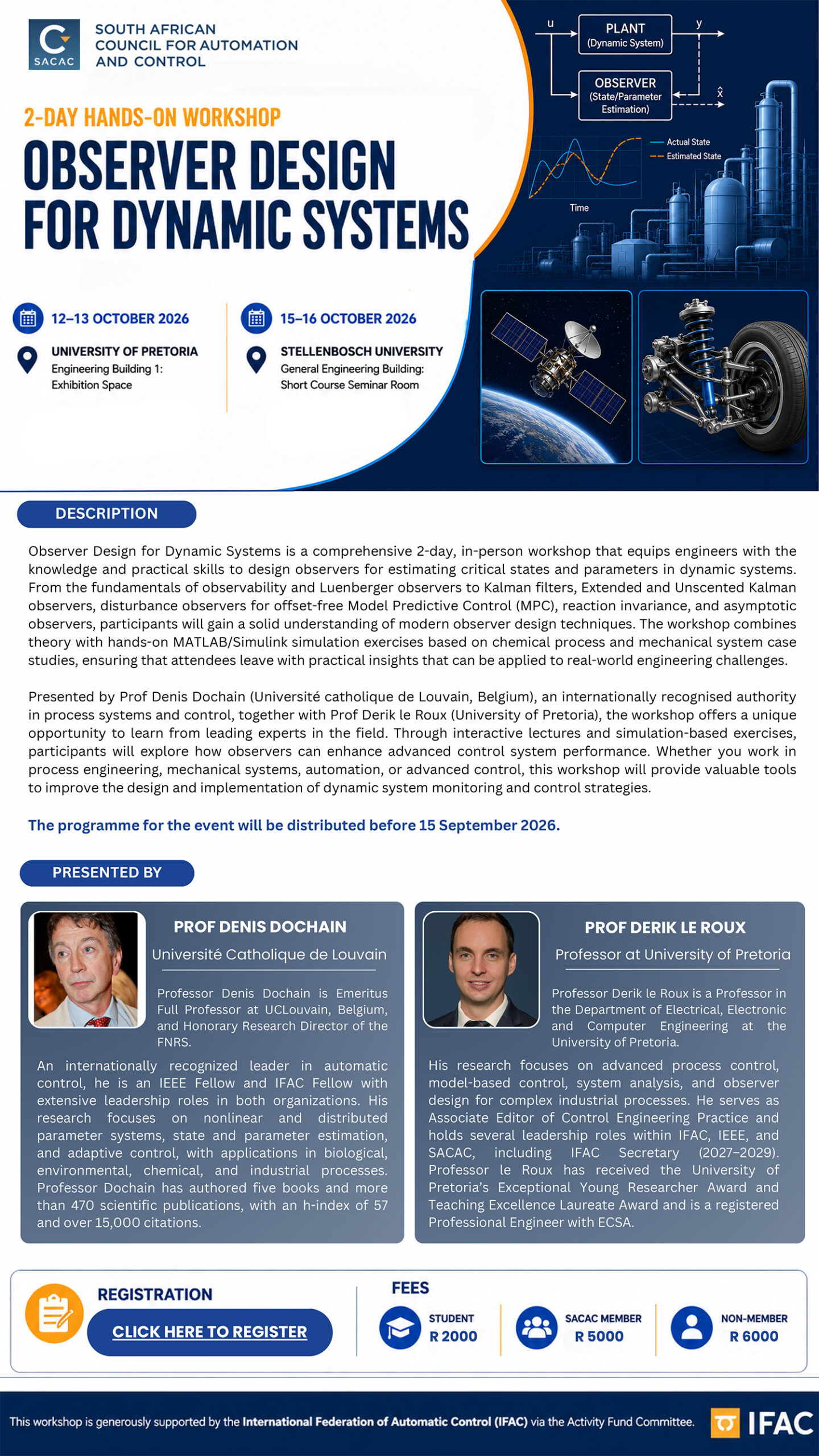
PROGRAMME
Day 1: Basics of Observers
This day covers the basic concepts of observability and observers.
| 08:00 – 08:30 | Registration + Coffee/Tea | |
| 08:30 – 09:00 | Introduction | Derik le Roux |
| What is an observer? How does it fit into a control loop?
The introduction aims to provide an overview of what an observer is, how it fits into a feedback control system, and why they are important. |
||
| 09:00 – 10:00 | Observability | Derik le Roux |
Observability is an important concept for the design of observers. The concept will be described mainly for linear systems, specifically some of the basic tests to evaluate observability. Observability in the context of nonlinear systems will be discussed briefly. |
||
| 10:00 – 10:15 | Coffee/Tea break | |
| 10:15 – 12:00 | Observers | Derik le Roux / Denis Dochain |
This section presents some of the foundational aspects of observers which is necessary to understand one of the most common observers, the Kalman Observer. |
||
| 12:00 – 13:00 | Lunch | |
| 13:00 – 14:30 | More Observers | Derik le Roux / Denis Dochain |
The most well-known observer, the Kalman Observer, will be discussed. Extensions of the observer for nonlinear systems and the tuning of these observers will be discussed. |
||
| 14:30 – 15:00 | Coffee/Tea break | |
| 15:00 – 16:30 | Simulations | Derik le Roux |
Participants will play with MATLAB/Simulink simulations to better understand the different observers. |
||
Day 2: Advanced topics
This day will cover the main topics as from the following articles:
- Pannocchia, G., Rawlings, J.B. (2003). Disturbance Models for Offset-Free Model-Predictive Control. AIChE Journal, 39(2), 426-437.
- D. (2003). State and parameter estimation in chemical and biochemical processes: a tutorial. Journal of Process Control, 13, 801-818.
| 08:00 – 08:30 | Coffee/Tea break | |
| 08:30 – 10:00 | Offset-free MPC using disturbance observers | Derik le Roux |
This section considers how Observers can be included in MPC loops to achieve offset-free setpoint tracking for MPC. It involves extending the model to include input/output disturbances, but with specific limitations. |
||
| 10:00 – 10:15 | Coffee/Tea break | |
| 10:15 – 12:00 | Asymptotic Observers and Reaction Invariants
The underlying idea of asymptotic observers is to take advantage of the structure of the dynamical models of a processes to rewrite part of the model in a form independent of the process kinetics. This structural property of mass and energy balance is closely related to the notion of reaction invariants. |
Denis Dochain |
| 12:00 – 13:00 | Lunch | |
| 13:00 – 14:30 | Decoupled parameter estimation
Improved estimation performance is possible if the state estimation and the parameter estimation are decoupled from each other. |
Denis Dochain |
| 14:30 – 15:00 | Coffee/Tea break | |
| 15:00 – 16:30 | Simulations
Participants will use MATLAB/Simulink simulations to better understand the different observer approaches. |
Denis Dochain / Derik le Roux |